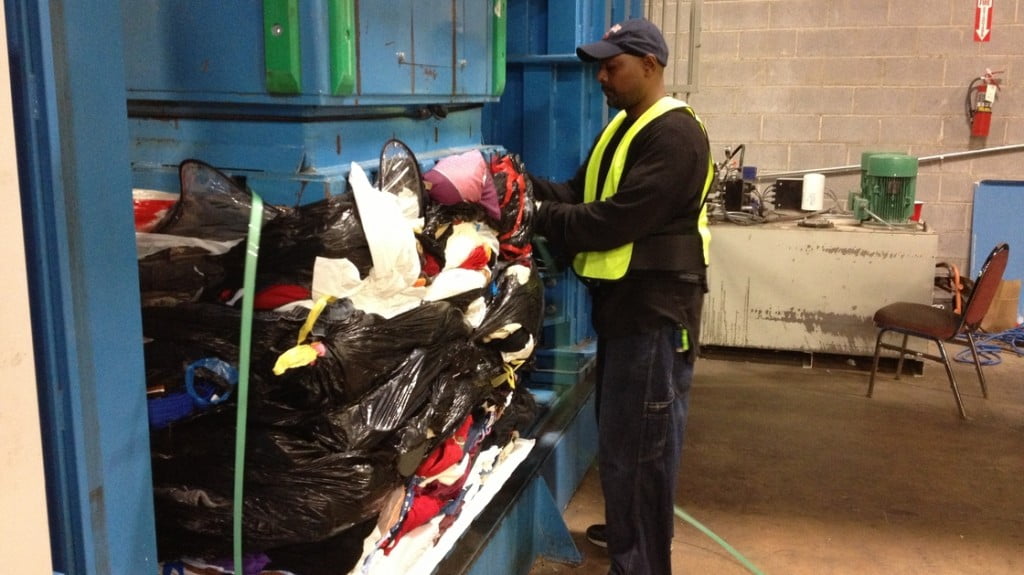
Clothing Recycling Goes Curbside as Demand Rises
April 29, 2013 by admin
Filed under Activism, News & Information, Recycled Clothing, Recycling, Resourcful, Shop Owner Notes, Sustainable Design, Sustainable Fashion, Textile News

goodwill donations source USA Today
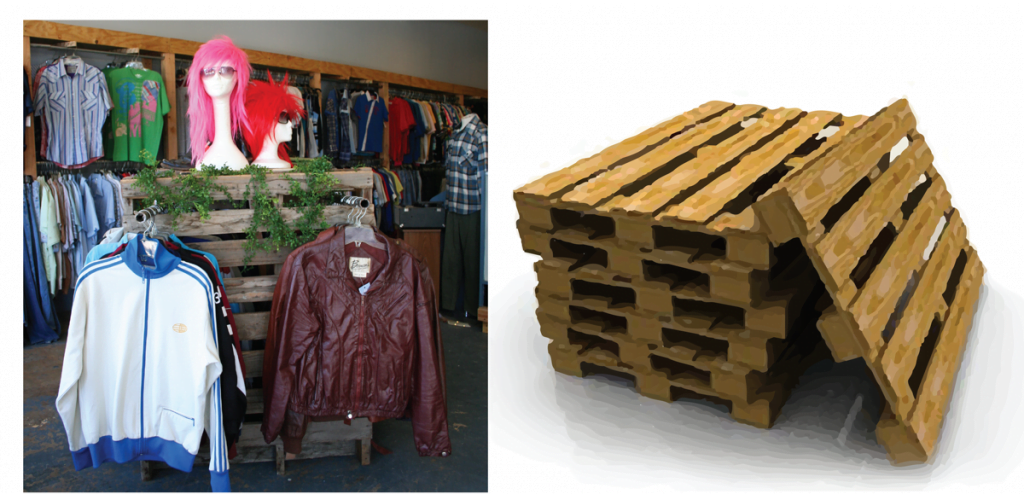
Did you ever wonder what happens to your clothing after you put it into a donation bin? Sometimes it ends up in a thrift store, sometimes it ends up in a vintage shop and sometimes it ends up being processed to be reused as a wiping rag.
Wendy Koch, an investigative reporter at USA Today recently took a look into the recycled clothing industry, where the clothes end up when you donate them and where they end up if you don’t. With the average American throwing out over 70lbs of used textiles a year, each one of us is responsible for what we do with our old duds.
From: USATODAY
Clothes recycling is expanding with curbside pickups and in-store collection bins, but what happens to donated items? USA TODAY’s Wendy Koch finds out.
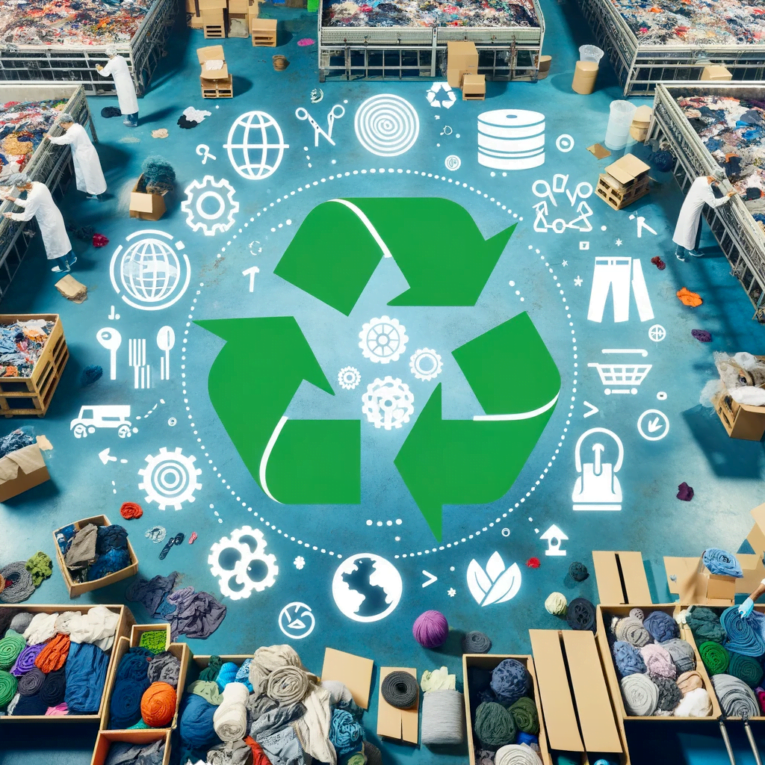
Clothes recycling is going curbside in more U.S. towns as global prices rise for the used apparel, shoes and linens that Americans often toss in the trash.
Since September, more than a dozen local governments — in Arizona, Massachusetts, New Jersey, Pennsylvania and Washington state — have begun curbside pickup of textiles, often in special bags next to bins containing paper and cans. New York City has put clothing collection bins in nearly 250 apartment buildings in the last two years.
Businesses, too, are placing collection bins in parking lots and gas stations. In the last year, The North Face, H&M and other retailers have begun using in-store bins to offer customers store vouchers for donating clothes — whatever the brand, and sometimes, whatever the condition.
The nation’s robust recycling industry is increasingly targeting clothes — even those that are stained, ripped, mismatched or out-of-fashion. Companies and non-profit groups are partnering with cities eager to reduce landfill costs. They pick up the clothes, sell or reprocess them into wiping rags and other goods, and give the cities or local charities a cut of the pie — often pennies per pound.
“”It’s a trend more cities are considering.” says Tom Watson, a recycling official in Washington state’s King County, where the Seattle suburb of Issaquah has teamed up with waste collector CleanScapes for curbside pickups. As a result, he says non-profits such as Goodwill Industries International and Salvation Army face more competition for donations.
Queen Creek, Ariz., launched a curbside pilot project in September that collected 27,000 pounds of material in four months and earned nearly $3,000 for both the city and its Boys and Girls Club. It partnered with United Fibers, a company that turns textiles into insulation
“This is stuff I wouldn’t want to give away,” says Ramona Simpson, the town’s environmental programs supervisor, referring to items that are no longer wearable and wouldn’t sell at Goodwill or other charity stores. She says the town, after developing a stronger bag for collecting clothes, will soon relaunch the program.
Salvation Army began partnering this year with Massachusetts’ Brockton and Worcester to pick up clothes curbside. Community Recycling, a for-profit that sells clothes for reuse, started pickups in October in Pennsylvania’s Newtown and a dozen neighboring communities and will do the same next month in Westville, N.J.
“Anything that is clean and dry can be reused or recycled,” says Jackie King, executive director of Secondary Materials and Recycled Textiles Association, an industry group. She says nearly half of donated clothes are sold for reuse, mostly overseas where demand and prices have risen.
Goodwill’s Michael Meyer says per-pound international prices vary but have risen from a low of about three cents to 20 cents. He says his non-profit, which requests “new and gently used” items to fund job training programs, sells the “vast majority” at its stores, outlets or auctions. What’s left, he says, is sold to companies that recycle the material into other products or sell them for reuse overseas.
King says the average American throws away 70 pounds of clothing, linens and other textiles each year. Textiles account for 5% of municipal waste, because only about 15% of them are recycled — compared with 72% of newspapers and 50% of soda cans, according to the U.S. Environmental Protection Agency.
“There’s a lot of room for improvement,” says Jennifer Berry of Earth911.com, a website that lists, by ZIP code, places where myriad items can be recycled.
“Clothes clog our landfills. They don’t decompose”, says Kelly Jamieson of Planet Aid, a non-profit with bright yellow collection bins in many metro areas. “We’re very privileged people. We throw away things many other people never would.”
Her group placed bins on college campuses nationwide last week as part of the “OneShirt Challenge” for Earth Day, aimed at educating students on the need to recycle even the rattiest T-shirts.
“My friends just let things pile up in their rooms, which is a pretty big waste,” says Jan Nguyen, a University of Maryland student who’s donating old athletic shoes. She says she rarely throws anything away and uses socks that have lost their mate as chalkboard erasers.
With super-cheap manufacturing. clothes are falling apart and being thrown away at a faster rate, says Heather Rogers, author of Green Gone Wrong: How Our Economy is Undermining the Environmental Revolution. “There’s been a transformation of clothing into a disposable item.”
Watson, the Washington recycling official, says consumers should consider buying fewer but higher-quality items that will last longer, noting the average American buys at least twice as many pieces of clothing as 20 years ago. He suggests they avoid impulsive purchases, take good care of their clothes and, when possible, buy used items at thrift stores.
Think Outside the Box : How to Make a Difference Starting With Your Wardrobe
August 23, 2012 by admin
Filed under Featured, Lifestyle, News & Information, Recycled Clothing, Recycling, Resourcful, Sustainable Fashion, Vintage Fashion Tips

Here’s the irony: fashion is short-lived while fabric and pollution are not.
After all of the inspiration, design, and excitement pass, the clothes remain. Heavy Flannel, Acid-washed denim, Break dancing pants. They’re out there still, in closets, thrift stores, and land fills. Eco-savvy fashion choices mean not only reducing post-consumer refuse, but also pre-consumer waste and pollution.
After its origins on the farm, forest, or oil field, each jacket spent some time morphing into its present form. What chemicals were used to grow it? Were the dyes safe? As more designers and manufacturers create with eco-concerns in mind, it’s easier to find satisfying answers. Through smart wardrobe management and consumer choices, you can cut down on closet clutter, support clean industry, and look fabulous.
The FAQs below provided by TreeHUgger will help you navigate all of the terminology and find the best ways to Make a Difference Starting With Your Wardrobe.
1.Shop with a plan
When you bring an article of clothing into your life, its kind of like adopting a dog or cat. That cute little number has to have a place in your wardrobe, and you’re agreeing to provide for and give it the longest possible life with you. Abandoning the impulse buy may sound boring, but how exciting is a closet full of stuff that doesn’t work? In the long run, knowing what you’re looking for before you shop will save time and eliminate clutter. You’ll get more use out of a piece that looks and feels great: What colors work for you? What fits work the best? How will the piece get along with everything else in the closet? If the answer to “Will I still want to wear this rhinestone-studded bustier in two years?” or “Can I eventually find a way to use it in a craft project?” is no, skip it
2. Love your duds
Whatever you’ve chosen, take good care of it. When you get home, change out of work gear and into your famous dressing gown or leisure suit. Don’t cook or check the tire pressure in clothes you want to wear in public. Learn how to sew a button back on, or how to coax a nimble friend into doing it for you. Get the name of a local tailor or seamstress for major repairs or alterations.
3. Don’t go dry
Though the industry has improved much since 1992, there is still a high likelihood that your trusty corner cleaner uses perc (tetrachloroethylene), a known carcinogen. See if there is a local green cleaner employing “wet cleaning” or liquid CO2 techniques. Many articles whose tags ask for the dry clean treatment can actually be hand washed, especially silk, wool and linen.
4. Buy vintage or used
People unload clothes for all types of reasons, and you know that adage about trash and treasure. From Oscar-worthy vintage dresses to Freecycled denim, you can likely find the piece you’re looking for second hand. You’ll be giving a cast-off garment a second life, and possibly supporting charitable work in the process. See Dust Factory for more.
5. Wash well
Washing wreaks the most havoc of all. It requires lots of water and energy, so only do it when you absolutely need to and have a full laundry load. Turn articles inside out and use the lowest temp possible. If you know you glowed all over a piece, make a thin salt paste and soak the affected fabric for a half hour before washing. Choose phosphate-free and biodegradable detergents and line dry as much as possible. Treat stains quickly with nontoxic removers. If you’re buying a new washing machine, look for one with an Energy Star label.
6.Wear organic
Though cotton is marketed as clean, fresh, and natural, conventional varieties are anything but. It takes a third of a pound of chemical fertilizers and pesticides to produce the cotton for one T-shirt! That means lots of direct, unhealthy exposure for farmers and nearby wildlife, and heaps of unnecessary pollution. Luckily, organic cotton is becoming easier and easier to find. As mega-stores get into the game, however, it’s important to stay vigilant about what organic means, so you know you’re really getting clean clothes. Also know that though the cotton may have been organic to start with, your T may be full of processing chemicals and metal-laden dyes. See below for more info on labeling and certification.
7. Find a re-construction
A re-construction garment used to be another or many other articles. Designers all over the globe have taken on this transformative challenge in recent years, with very wearable results. This means a one-of-a-kind look for you, a new life for old fabric, and a livelihood for maverick re-users. See Particle Clothing for More.
8.Approach new fabrics with skeptical enthusiasm
No doubt you’ve heard the hype around bamboo, soy, or even corn fabric. The idea of finding alternatives to petrochemical-based and conventionally grown options makes us all perk up and we see why many eco-conscious designers are excited about them. Bamboo, for instance, sounds great: it’s a fast-growing plant, not reliant on chemicals, and beautifully drapes the human form. Trouble is, bamboo plantations can displace native forests, and the harvesting and fiber processing are often polluting and unregulated. As with soy, corn, and Tencel (which comes from trees), the processing from plant to fabric is energy and resource intensive. For now, approach these as alternatives to poly, nylon, acrylic or conventional silk and await more info. As always, shop with a plan: don’t fill multiple shopping bags just because the labels say “eco.” Read more about fabric choices below.
9.Choose clothes that work for you
It’s hard to feel beautiful in your raw silk dress when it’s likely that children’s scalded hands were part of the production chain. Conventional clothing might not say it, but clothing made under fair-wage and labor practices will usually advertise it. SweatShop Watch and Behind The Label are good sources of info. See more resources below.
10.Don’t throw it all away
Finally, a stain, a tear, or changing fashion threaten to separate you from your favorite dress shirt. Don’t just abandon your old friend to the waste-stream! If the condition is perfectly good, you can always donate or Freecycle it (see below for donation resources).
DO MORE
1. Speak up
Tell your favorite boutique or department store that you want clean fabric or re-used options.
2.Get it re-made
Once you have a tailor or seamstress, take in last year’s clothes for an overhaul. That stained sweater could become a cardigan, and that too-tight dress, a skirt.
3.Swaporamarama
Get together with pals for fizzy drinks and a clothing swap. If it’s new to you, it’s new for your friends as well.
4. Activate
Join the Organic Consumers Association’s Clothes for a Change Campaign.
5.Make donating a snap
Planet Aid places bins in convenient places to make donating old wearables easy. Is it easy for people to donate in your community?

THE FACTS ABOUT RECYCLED CLOTHING
1. The average American throws away about 68 pounds of clothing and textiles per year.
2. 10% of all agricultural chemicals and 25% of insecticides in the U.S. are used to grow cotton.
3. It takes almost 1/3 of a pound of chemicals (pesticides and fertilizers) to grow enough cotton for just ONE T-shirt
4. Seven of the fifteen pesticides used on cotton are considered “possible”, “likely”, “probable”, or “known” human carcinogens (acephate, dichloropropene, diuron, fluometuron, pendimethalin, tribufos, and trifluralin) according to the US Environmental Protection Agency.
5. Some studies have shown that organic farmed soils have a better ability to absorb and retain carbon, which would be beneficial in the fight to reduce global warming.
6. Organically grown crops also use less fossil fuel than conventional crops, another benefit in the fight to reduce global warming.
7. Pesticides are suspected to be responsible the severe drop in honeybees, the increase in frogs with extra legs and eyes, and annual death of 67 million birds.
8. The U.S. textile “recycling industry” (which actually re-purposes rather than recycles), with some 2,000 companies, removes annually from the solid waste stream 2.5 billion pounds of post consumer textile product waste.
1.What makes clothing organic?
Organic clothing comes from all-natural materials (no synthetics like polyester or rayon) and there are no pesticides, herbicides, fungicides, rodenticides, radiation, or genetically modified organisms used when growing the cotton/hemp/linen, or whatever plant we’re talking about.
Organic certification is complicated. According to the Organic Trade Association, organic cotton is grown in 12 countries, with Turkey and the United States leading the pack. There are a number of certifying bodies around the globe including: Demeter (Europe), KRAV (Sweden), Naturland (Germany), SKAL (Netherlands), The Soil Association (England), The Japan Organic Cotton Association, The International Natural Textiles Association (Germany), the USDA, and more. The International Federation of Organic Agriculture Movements (IFOAM) strives to create international standards, and certifies the certification schemes of individual nations.
The Institute for Market Ecology provides on-location certification on behalf of many of the organizations listed above, and according to the Organic Cotton Blog, is certifying Walmart’s and Sam’s Club cotton.
The Organic Trade Association has developed certification for fiber processing. What does this mean? Clothes certified organic will arrive having been processed, dyed, transported, etc. in the most non-toxic manner possible.
What are the various meanings of “sustainable” and “organic” clothing? Check out this informative examination from the Organic Clothing Blog. The Fiber and Fabrics section in general is a great place to learn about hemp, wool, bamboo… And the associated Lotus Organics Clothing, Fiber and Fashion glossary contains most of the fiber definitions you would ever need.
So now you know.

More Interesting Facts About Textile Recycling
May 24, 2012 by admin
Filed under Activism, Featured, News & Information, Recycled Clothing, Resourcful, Textile News

Did you know that over 70% of the world’s population uses secondhand clothes. That does not include the US where the average American throws away over 70lbs of clothing a year. Believe it or not the Vintage Clothing or Re-used/Recycled clothing industry is responsible for saving over 1 million ton’s of textiles from ending up in our land-fills each year.
Without the help of clothing and textile recycling outfits around the world this would not be possible. One of these textile recycler comanies SAgain has published a list of eight “insane” facts about textile recycling. While I wouldn’t employ that particular adjective, and clothes “recycling” would be more accurately termed “reuse,” it’s still a cool compilation of info about a unique corner of the industry.
Brought to you by USAgain
- The average lifetime of a piece of clothing is only about 3 years.
- The consumer is the biggest culprit. In the U.S., 75% of pre-consumer textile waste is recycled by manufacturers, but only 15% of post-consumer textile waste is recycled.
- The average American throws away about 70 pounds of clothing, shoes and other household textiles each year.
- Americans generate almost 13 million tons of textile waste per year. Brits generate about 1.12 million tons of textile waste a year.
- Even though the UK appears to generate less textile waste, One in five Brits admit to throwing away a garment after a single wear. This means that more than $127 million of clothing winds up in landfills each year after being worn once. (One in five Brits also think that light sabers exist.)
- One in four American women own seven pairs of jeans, but only wear four of them regularly. (One in Four Americans also don’t know what nation the U.S. declared independence from.)
- The U.S. textile recycling industry creates around 17,000 jobs and removes 2.5 billion pounds of post consumer textile product from waste stream each year.
- Over 70% of the world’s population uses secondhand clothes.
Science Friction
May 2, 2011 by admin
Filed under Architecture & Design, Eco Friendly, Featured, Home & Garden, News & Information, Recycling, Resourcful, Sustainable Design

Paper is hands down one of the biggest success stories when it comes to recycling. We are slowly gaining ground with aluminum, plastic and textiles but we still have such a long way to come. Designer Merryn Haines-Gold has come up with a way to recycle paper other than throwing it into the blue bin, he made a chair. To make this great chair he used the recycled wooden frame from an old directors chair and old magazines along with loose bits of paper to remake it into a functioning chair.
Friction from the design holds the chair together, not glue. Each piece of paper is laid over each other, similar to like when you are shuffling a deck of cards wrapped with a a single strip of plastic. The seat bonded to the chair by tie wraps that are connected through small holes that are drilled into the paper.
The design is a available for sale, but the designer also presents it as a DIY project for you go getters out there.
That is the beauty of the idea, it is very simple and can be recreated anywhere with any magazine you wish, it also does not even have to be a magazine, it can be loose bits of paper, as long as they are roughly the same shape and the surfaces are able to engage with each other, the friction will do the rest…..just don’t leave it outside.
This looks like a fun weekend project for just about anyone out there. Next time you see a beat up directors chair at a garage sale or flea market keep this idea in mind. With a collection of some old magazines you can have a cool green project to work on. At the very best you will have a great new art piece that people can sit in, at the very least you will learn a little bit about how friction works.